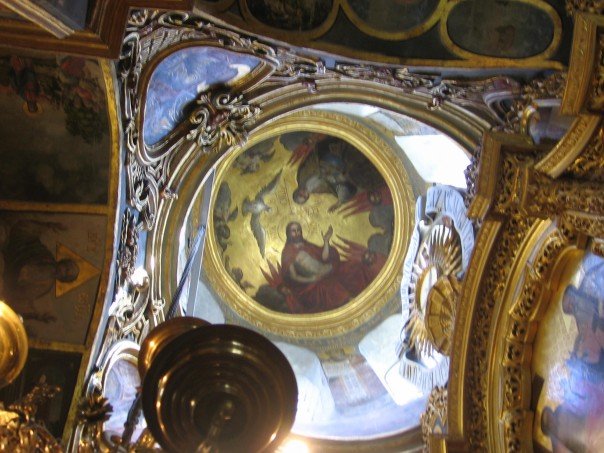
I’ve been asked a few times lately about the apparent growth in the Orthodox and Roman Catholic Churches. This topic is growing in the vision of the current generation as it longs to discover authenticity in all things, but especially in faith. In a metamodern world that creates “truths” and then inflicts them upon others, finding that stable and ancient heritage is at the focal point.
So first, some stats: NBC reported that Easter 2026 saw an increase of over 30% in attendance at Catholic churches in the US. NBC also notes that the Roman Catholic Church has seen a 40% increase in the past 20 years. (Keeping in mind that the share of Catholics in overall US population is below 20% in a longer trend of decline.)
Regarding the Orthodox church, The Gospel Coalition states that there have been reports as high as a 78% increase in Orthodox converts since the pandemic. While the overall population of Orthodox among the US population is still 0.7%, it still has seen an accelerated rise. According to the Orthodox Studies Institute, about 65% of the converts are coming from Protestant churches.
It also bears stating that the Southern Baptist denomination has seen a decline in membership each of the past 19 years, but with baptisms being up 4% as well as attendance growing in many areas. In reference to the total US population, it is estimated that 3-6% identify as evangelical non-denominational and 4% as Southern Baptist.
So what’s the deal?
Following I want to give some of the reasoning that I have regarding the Catholic and Orthodox churches and their faith practices. I don’t intend to bash those Christians in Catholic and Orthodox Churches, but rather want to give a view into my outlook on them and why it seems like they are growing with young people from Protestant backgrounds.
[I also want to mention here that a ton of my learning on these branches of Christianity comes from the time that I spent in Poland and in Ukraine while in college. In Poland, I spent a lot of time with Catholics and in Catholic churches. According to many of my Polish friends, “To be Polish is to be Catholic.” It was extremely culturally ingrained. The city that I lived in even had a relic called the “Black Madonna” where pilgrims would come and pray for healing. While in Ukraine, I spent time at the Lavra in Kiev, including going into the crypts where I saw pilgrims kissing the mummified hands of saints. More recently, I’m beginning to learn about Coptic Christianity which is one of the oldest continuing branches of Christian practice. It’s one thing to read these things in books, another to see them flow through the hearts of friends. Please keep that love and charity in mind while reading.]
First, some observations on basic beliefs.
Catholics and Orthodox Christians are sacramental in their basic belief system. This term refers to the means by which they believe that grace is given from God to people. In sacramental churches, there is a strong belief that Jesus has given the Church (i.e. their Churches) the right to dispense grace. In real terms, the Catholic Church specifically believes that when the priest is doing the work of his office he is literally standing in the place of Christ. Thus the priest on behalf of Christ by the empowering of the Church is absolving sin, sanctifying the bread and wine to literally become the body and blood of Christ (transubstantiation), and allowing the individual entry into the Church and thus into salvation. Apart from the institution of the Church, in the Catholic and Orthodox mindset a person cannot be saved.
Thus, infant sprinkling or baptism is the Church bringing people into the belief. It doesn’t matter their intention, rather it matters that the Church wills to bring them in.
In the Orthodox mindset, the priest stands as an “icon” of Jesus, a direct conduit for his grace. While this is a step away from the Catholic belief, it still effectively places the priest in the seat of Christ. He, through the investiture of the Church, serves as the vessel through which Christ literally distributes grace to people.
Additionally, the Catholic and Orthodox Churches have the direct belief that a person is saved by their works. Many current Orthodox teachers don’t shy away from directly saying it, while others try to skirt the issue.
As for the cult of the saints, the dogma of the Church does not deify them. Rather they are seen as part of the “Church invisible” and that as they serve in the throne room of God, they can continue to offer prayers up to God on the behalf of the supplicants. Mary has a special place as the “God-bearer” and in Catholic dogma is believed to be sinless in her own right, but the intention of prayers to Mary echoes that of the saints. While this is the dogma, it could be argued that the majority of worshippers in Catholic and Orthodox churches don’t make the distinction, and instead of asking these saints to intercede on our behalf they just pray to Mary and saints.
The point of icons needs to be addressed as well for the Orthodox Church. Icons are artistic renderings of Christ and Mary that are designed to give a view into heaven. On one end of the spectrum of belief, they are worship aids that call the mind and spirit to worship in the heavenly places. On the other end of the spectrum, the icons are sought for healing powers like a manifestation of the heavenly on earth. They are central to the worship of the Orthodox Church. The Catholic Church (depending on region) also uses icons, but more often they are termed as relics.
One will ask, “If the Bible teaches that salvation comes by grace through faith, and that there is no intercessor other that Jesus himself, why do the Orthodox and Catholic Churches not align to the teachings of Scripture?” Additionally, why would these churches hold extrabiblical texts (like the Apocrypha) as authoritative?
The belief in Orthodox and Catholic Churches is that the Bible is subservient to the Tradition of the Church. As the Church is Christ’s literal representative on Earth, they believe that the Church has the ultimate interpretation on spiritual matters, though hopefully normally aligned with the Bible. But in areas where they disagree, the Church wins because the priest stands in the place of Christ.
This is a ham-handed explanation of these sacramental churches, but I think there has to be a baseline of understanding of the difference between Evangelical Church (salvation by grace through faith, the inerrancy and authority of Scripture, the abolition of the priesthood, memorial view of Eucharist) and Orthodox/Catholic Churches.
So what is the draw of the Orthodox/Catholic Churches to so many new converts?
First there is a belief that because of the ancient nature of the Catholic and Orthodox Churches that they are more legitimate. There is a feeling that Catholic and Orthodox practice of worship hasn’t changed over the millenia, and thus they are more accurate and dependable. Additionally, there is a belief that the unitary nature of these churches lends authenticity.
While this logic is inherently flawed (just because something is old doesn’t make it better), it also is a misunderstanding of the developments of the Church over history. Ethnic distinctives and influence by surrounding culture have always been a part of the development of the practice of the Church. Consider first the language. Catholics insisted that Latin (the language of the pagan Romans) was the language of heaven and insisted its use in Mass up until the 1960s.
Orthodox insist that Greek or Cyrillic (or whatever other ethnic dialect that was being used) is the best language. But for the Orthodox Church, much of its organization comes around ethnic lines. Thus in the Orthodox faith, there are at least 15 different branches of the Orthodox Church, almost always divided by ethnic group. While this practice of restricting Orthodox worship along ethnic lines (phyletism…new word for my vocabulary) was condemned at the Pan-Orthodox Council in 1872, the vast majority of contemporary Orthodox churches still run along ethnic organization. They will contend that they are one belief, but with various popes and Metropolitans, this is not a meaningful division.
In fact, the main points of the original schism of the Western and Eastern Church in 1054 center around the authority of the Pope in Rome vs. the Eastern bishops (and primarily the Metropolitan in Constantinople) and the theological argument of where the Holy Spirit proceeds from (just from God the Father, or from both the Father and the Son, called the doctrine of filioque).
It bears mentioning that many of the Church Fathers would be considered sacramental in their theology. This designation of “Church Father” certainly means leaders before the birth of the Roman Catholic Church (that’s a journey for another post). But many of the earliest Christian writers would espouse sacramental practice and venerated the saints. Without going and making a more systematic study at the moment, this is undeniably the case. However, their proximity to Christ (most of those referred to would have been alive within 200 years of Jesus) does not indicate infallibility. If they are believers like you and me (and Scripture makes it clear that they are, such as Elijah in the book of James), then their word does not stand as the Word of God. They comment on it, interpret upon it, but they are not the prophets or Apostles. So following sacramental theology because the Church Fathers did it is more of a choice than a compulsion.
And in case you think that the beliefs of the Reformation all came from only 300 years ago, there have been groups practicing these beliefs in small areas over the centuries, such as the Anabaptists, Franciscans somewhat, Waldensians, Hussites, Lollards, the Devotio Moderna and more (and those were just in the West). The core of the Reformation itself came from a desire to return to the original sources of the Greek and Hebrew Bible.
A second draw is the mysticism of the sacramental churches. The interaction with the invisible Church in the heavens and the beauty of millenia of art in worship are certainly big influences. The sacramental churches have really developed a wonderful view of the beauty of God in eternity, and evangelical churches really can learn from them.
But as with most things that are foreign to our background, things are only mysterious and exotic until they become commonplace. And when it comes to commonplace mysticism, the practice of worship almost always slides into idolatry, or worship of the practice of worship itself. Hear me when I say that not all sacramental churches are engaging in idolatrous worship, but many certainly are. Where there is a lack of intentional understanding, the leaning on a professional intercessor to do the work of ministry for us, and experiences/languages that are foreign to us, it becomes simple to worship the things that are seen against the things that are unseen. (It should be noted that evangelical churches also struggle with this kind of idolatry at times, particularly in performative worship, but I digress.)
The third (and I think strongest) reason that people are moving toward sacramental practices of faith is authority. Because of their belief that the priest stands in the place of Christ, the leadership of the church is absolute. They are strong in their belief and unflexing in their carrying out of that belief. The Orthodox Church in particular calls men out to be the leaders of their home, and unapologetically calls families to follow traditional family roles. They are grasping the adventurous spirit of manhood and calling men to account. They believe what they believe and are unapologetic about it. This kind of calling to manhood strikes a real cord in the heart of men looking for purpose.
Because of metamodernism’s push toward people creating their own truth and because of culture’s continuing disgust with that methodology, those seeking truth are looking for those that would lead from authority. The hyperemotional and home-cooked version of much of evangelicalism holds a weaker draw.
On top of this, the exposure of young people to the methodologies of evangelicalism have bored them. In their young adulthood, they are seeking meaning and purpose. Much of evangelicalism (and definitely mainline Protestantism) is telling them to follow their heart, which they know in their spirit is a bankrupt ethic that has caused them a lot of personal pain. By this, I mean that young people have watched selfish intent, greed and lust of the previous generation ruin much of the freedom in grace that the evangelical church preaches. The sacramental churches tell them not to follow their hearts, but follow the church. And to people who are seeking a truth outside of themselves this has a great draw.
Overall, my feeling is that the current wave of sacramental growth is mostly centered around a craving to be led by truth in a stable environment. In a world of fake news and shifting morality, usually the Orthodox Church and Catholic Church are clear on what they believe in and the direction they are marching.
So if this is where I perceive the draw is coming from, why do I continue in evangelical ministry?
I believe that the Word of God is the authority upon which we stand. Unlike politics, nations, and languages that will come and go, the inspired writings of the Bible do not change. The teachings of Jesus, the words of God through the prophets, and the teachings of the Apostles are as sharp and cutting today as they were 2000 years ago. Scripture predates the Church Fathers, and the ecumenical councils are also predated by Scripture by 300+ years.
If the Word of God is the authority, then the doctrine of the evangelical churches is trustworthy. Salvation comes by faith through grace, not by works so that none can boast. There is no need for another intercessor other than Jesus. All believers are a royal priesthood, called to speak the words of God to the world. The Church is not an institution, it is a chosen people, the gathering of the people of God in obedience to worship him and serve one another. We are not to lord it over one another but to serve one another as Jesus served us, and to keep Jesus preeminent amongst us. The ordinances of eucharist (communion) and baptism are memorial and symbolic in nature, but by the promise that where two or three are gathered that Jesus is there among them, it is very true that Jesus is present in the practice of the church.
I do not worship practice, tradition, or routine. I do not worship the charisma of leaders. I love the church dearly, but I love Jesus first.
And hear me friends, know that if you are a believer and are a part of the Orthodox or Catholic Church I’m not judging you. It is always about Jesus and his grace, and the Bible tells us that belief in Jesus as the Son of God is the key to everlasting life and that if we believe in our heart that Jesus is Lord and confess with our mouths that God raised him from the dead, then we will be saved. We are saved by the Son of God. My hope for evangelical belief is not based in hatred of sacramental churches. It’s based in my observations of what is written in the Holy Bible.
There’s a reason the Reformation occurred over 300 years ago. There’s a reason why people of conviction and holiness decided to seek the will of the Father for themselves instead of allowing a priest to do it for them. There’s a reason why scores of people died for the Bible to be translated into your language.
There’s a reason why you (more than likely a Gentile) received a faith that was foreign to you that allowed you to be grafted into the family of God.
It’s because Jesus loves you.
And he’s always been enough.
Signs and Wonders y’all.
16 “For God so loved the world, that he gave his only Son, that whoever believes in him should not perish but have eternal life. John 3:16

 And yet, and yet...
Leave a comment